

Introduction
Peanut (Arachis hypogaea L.) producers in the Southeast U.S. consistently face the question of whether seedling emergence results in populations adequate to produce optimal yields. In some instances, producers may replant fields unnecessarily or pass up an opportunity to replant when it could be beneficial. The decision to replant in peanut production can be challenging to assess because of the crop’s unique growth habits. Previous studies have demonstrated that a supplemental replant strategy is a viable option using a parallel, offset singlerow planting technique to increase the existing population rather than terminate the initial stand and start over (Sarver et al., 2016; Sarver et al., 2017; Tubbs and Monfort, 2022b).
Replant studies have been conducted in other agronomic crops including corn (Zea mays L.), soybean [Glycine max (L.) Merr.], and wheat (Triticum aestivum L.). Most crops can benefit from replanting when populations drop below a certain threshold. However, the results are varied. With respect to corn, supplemental replanting can be detrimental since competition among corn plants, due to uneven growth, can reduce the respective contribution of yield by the initial plants (Liu et al., 2004). Only extremely low plant stands (20,000 plants/ha) benefited from a supplemental replanting, and this was not as successful as removing the initial stand and completely replanting the crop (Terry et al., 2012).
Similarly in soybean, supplemental replanting into an existing stand is not recommended (Robinson and Conley, 2007; Whigham et al., 2000). The plant’s ability to compensate will often outweigh the cost of replanting. Albeit, some results demonstrated a benefit to supplemental replanting in certain circumstances, especially when replanting occurred early enough (Gaspar and Conley, 2015) or when stand reduction was extreme (66% reduction in stand, and cultivar-dependent) (Vasilas et al., 1990).
In wheat, when populations are considered “below optimum”, recommendations exist to thicken the stand by replanting the existing stand by “cross drilling”, or planting at a 45-degree angle to the original row (Bean and Duncan, 2024; Campbell, 2018). In Kansas, replanting is warranted when the partial stand is ≤ 50% of the target stand (Campbell, 2018). The recommendation to replant in Texas is when the stand is < 40% of the target population (Bean and Duncan, 2024).
For peanut, the decision to replant must be made early during the growing season to reduce injury to the established plants but also prevent too much separation in the progression of pod maturity toward the end of the season. Since peanut is an indeterminate crop, there is not a definitive maturity date. Optimum maturity is determined by assessing how much maturity is gained with later-developing pods while minimizing losses from overmaturity of the earliest-developing pods (Williams and Drexler, 1981). When using a supplemental replant strategy, the initial and replanted plants are at different growth stages. This creates even greater variability in pod maturity at harvest. Therefore, managing the crop’s population and maturity are both important to achieve optimal plant populations and yield (Tubbs and Monfort, 2022b).
Previous research on replanting peanut is helpful for producers to determine when to replant in sparse, yet uniform plant populations. However, those findings do not address replanting when nonuniform populations occur from gaps of varying length. Information is still needed for producers to determine when supplemental replanting would be beneficial for fields where portions of the row have uniform populations, yet there are segments of row where there are no plants. Short gaps within peanut rows are common in many fields and can be caused by a multitude of reasons – mechanical malfunctions during planting, a pest hotspot (especially disease or insect), soil inconsistencies (clods, puddling, pH/nutrient fluctuation, etc.), a small portion of the seed bag that got wet or experienced extreme temperature causing splitting or sloughing of the seed coat (and seed treatment), or a number of other circumstances. Determining the most effective methodology for replanting in those situations has not been addressed in previous studies, and knowing the length of the gap and proportion of the row with missing plants would be beneficial in deciding whether to replant those portions of the field.
In addition, Tomato spotted wilt (TSW; Orthotospovirus) is a pathogen of significant importance in peanut and can inhibit plant growth and development, thereby reducing yield. Studies have assessed the relationship between plant populations and the severity of TSW. Establishing an adequate plant population is important in managing TSW as nonuniform populations and poor emergence increase risk to the virus, regardless of the variety planted (Branch et al., 2003; Culbreath et al., 2003; Srinivasan et al., 2017).
To assess whether there is any benefit to replanting a poor stand of peanuts by planting only the parts of a field where gaps exist, a study was conducted. The overall objective of this study was to determine the optimal method of replanting peanut rows when varying gap lengths occur in sparse plant stands. To determine whether the overall objective was met, a series of subobjectives were used to compare and identify differences in yield, grade (total sound mature kernels [%TSMK]), and incidence of TSW. These included:
- Do differences exist between the recommended plant population of 13.1 plants/m (Tubbs and Monfort, 2022a) and a reduced stand of 6.6 plants/m (based on a 91 cm single row spacing)?
- Does a supplemental replanting of the reduced 6.6 plants/m population provide benefits over leaving the stand alone?
- When segments of row are missing (gaps), is there a benefit to replanting? a. Replant only in the gap?
- Is there a minimum gap length before differences are observed?
- What proportion of the row can have gaps until differences are observed?
b. Replant the entire row?
Materials and Methods
Experiments were conducted at The University of Georgia (UGA) Lang-Rigdon Farm in Tifton, GA (31.51698, -83.54796), during 2017, 2018, and 2019. Land preparation included discharrowing, deepturning with a moldboard plow to a depth of 30 to 35 cm, and rotary-tilling to form peanut beds 1.8 m wide. Trials were planted with the ‘Georgia-06G’ peanut cultivar (Branch, 2007) (Table 1). The field was visually evaluated for evidence that emergence was complete (no additional soil cracking from emerging seedlings) before thinning to specific populations. Once thinning was complete, rows were replanted according to their respective treatments (Table 1). The crop was managed according to UGA Extension peanut production guidelines (UGA Peanut Team, 2022). Rainfall and temperature data for these seasons are available at http://www.georgiaweather.net/ (verified 21 Aug. 2026). Irrigation was applied to supplement rainfall to meet the crop’s weekly water demand (Porter, 2021).
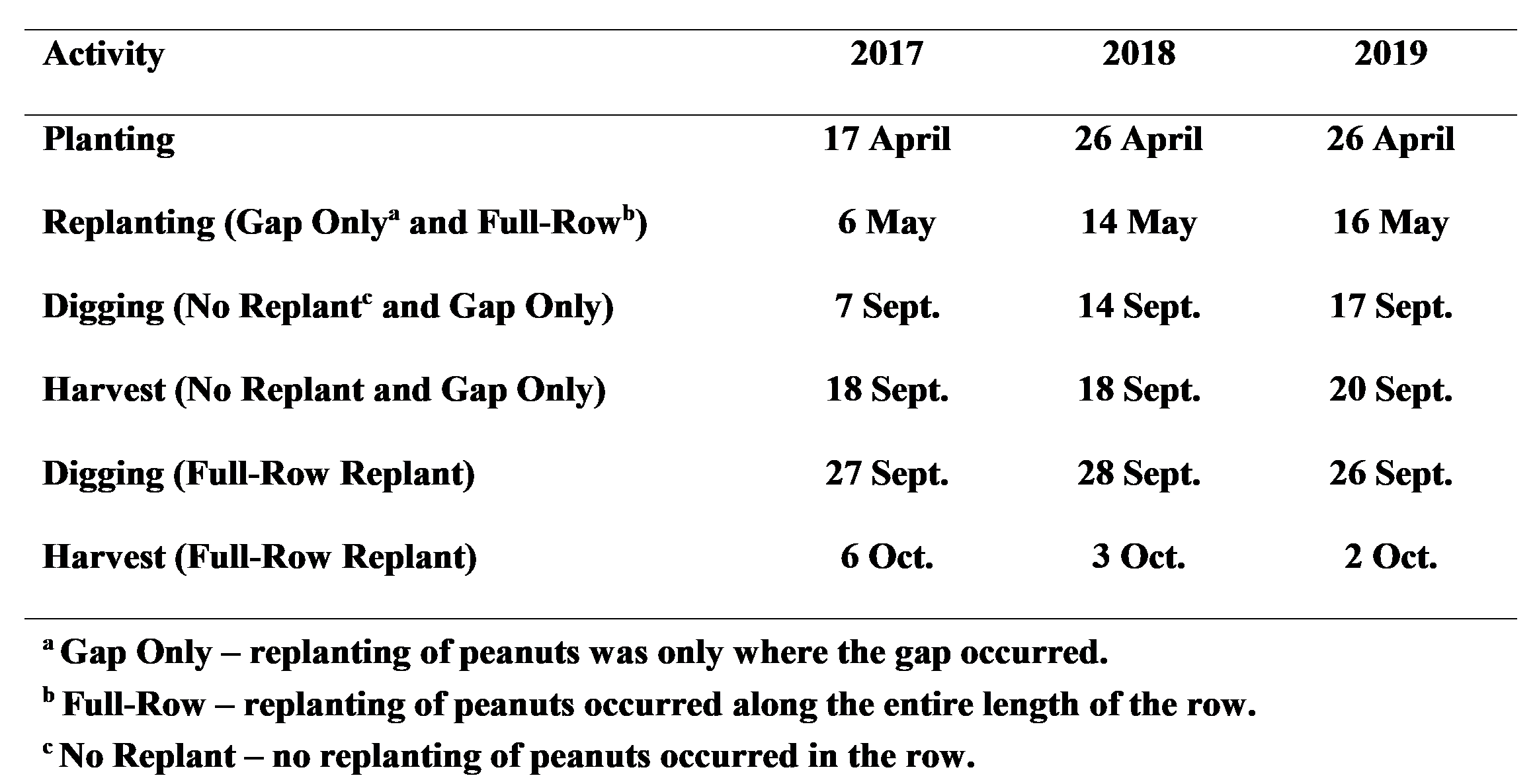
Dates for planting, replanting, digging, and harvest activities for gap replanting trials from 2017-2019, Tifton, GA.
All plots were 3.7 m (four rows) in width with 91 cm single row spacing and 10.4 m in row length. A randomized complete block design with four replications was used. The check plots were established as follows:
- Population was maintained at 13.1 plants/m (143,500 plants/ha) with no gaps in the row to simulate the UGA recommended population.
- Population was thinned to 6.6 plants/m (71,750 plants/ha) to simulate a uniform sparse plant population.
- Population was thinned to 6.6 plants/m (71,750 plants/ha) and the entire length of row was replanted approximately 7.6 cm to the side of the initial row with a seeding rate of 13.1 seeds/m as a supplemental replant.
In addition to the check plots, this trial was designed to include a two-factor factorial of variables including gap treatments and replant methods. To establish gaps, random sections of the row were selected (at least 0.9 m from the ends of the row) for additional plant removal to form gap segments within the row. The gap treatments included:
1. 61-cm gap that occurred once per row (6% of row missing).
2. 61-cm gap that occurred twice per row (12% of row missing).
3. 122-cm gap that occurred once per row (12% of row missing).
4. 122-cm gap that occurred twice per row (23% of row missing).
5. 183-cm gap that occurred once per row (18% of row missing).
6. 183-cm gap that occurred twice per row (35% of row missing).
The replant methods included:
- No replant with rows left as is (“no-replant”).
- Replanting only in the established gaps within a row (“gap-only”).
- Replanting the entire length of the row (“full-row”).
These gap lengths were selected because most calls from county extension agents requesting a recommendation on behalf of a grower’s concern regarding “unacceptable” plant stands are initiated when gaps in rows are at least 61 cm in length. Shorter gaps are either unnoticed or considered negligible because of the peanut plant’s ability to grow vine and compensate for the missing area. Additional 61 cm increments were chosen to allow ample gap lengths so vines from adjacent plants within the same row would be less likely to fill in all available space by the end of the season.
After gaps were established for each treatment, the remaining section(s) of row maintained plant populations of 6.6 plants/m. The “full-row” and the “gaponly” replant treatments were seeded in a new furrow approximately 7.6 cm to the side of the initial row with a seeding rate of 13.1 seeds/m. The initial planting and the “full-row” replanting were accomplished using a Monosem precision air planter (Monosem-Inc., Edwardsville, KS) to a depth of 5 cm. Furrows for the “gap-only” replant method were created with the Monosem planter while dropping no seed and leaving the furrow uncovered, then planted manually to a depth of 5 cm. This furrow was covered manually and firmed by stepping heel-to-toe on top of the length of the segment.
Treatments were evaluated for pod yield (kg/ha), grade (%TSMK), and incidence of TSW (percentage of row with visual symptomology). Peanut maturity was determined using the hull scrape maturity profile method (Williams and Drexler, 1981). Peanut digging and inversion were conducted using a two-row KMC digger (Kelley Mfg. Co., Tifton, GA). The “no-replant” and “gap-only” treatments were dug and inverted before the “full-row” replant treatments due to differences in maturity assessment each year (Table 1). Peanut pods were allowed to dry until moisture levels were approximately 10-15% before they were harvested with a tworow KMC harvester (Kelley Mfg. Co., Tifton, GA) (Table 1). Pod yield was adjusted to 7% moisture for uniformity across all plots. The grade was determined by the USDAAMS grading guidelines (USDA-AMS, 2019) and performed by the USDA Federal-State Inspection Service in Tifton, GA.
The TSW ratings were conducted on 23-25 July during 2018 and on 12-14 July during 2019 (no ratings were made in 2017 due to very low incidence in this experiment that year). The TSW ratings were conducted mid-season to allow assessment of the population before full canopy closure and vegetative growth of initial plants covered symptoms of smaller replanted peanut plants. The incidence of TSW was determined for the presence of symptoms in each 8 cm section of row for the entire length of the row and converted to the percentage of row where the virus was deemed present. To achieve these ratings at such a small interval, a tape measure was placed along the entire length of the row to determine where an incident began and ceased. In the “no-replant” treatment, the total gap length was deducted from the total row length assessed to determine the percentage of TSW incidence only from where plants were present.
Data for yield, grade and TSW incidence were analyzed using JMP PRO 15.0.0 (SAS Institute Inc., Cary, NC). The model used for the data was a mixed-effects analysis of variance (ANOVA), with check plots, gap treatment, and replant method as fixed effects while block and year were random effects. According to the random effects covariance parameter estimates, year and block were insignificant. Data were first analyzed by ANOVA for all treatments, and differences among means were determined using Tukey’s honestly significant difference test (Tukey, 1949) (α = 0.10). Due to the conservative nature of this post-hoc test, an α = 0.10 is often suggested, as noted by Steel and Torrie (1960). This analysis allowed the check plots to be included and compared to all other treatments. However, since the check plots caused an unbalanced design with regard to the remaining two-factor factorial arrangement, the check plots were also analyzed separately from the factorial arrangement by ANOVA, with differences among means determined by pairwise t-tests (α = 0.10). Finally, the checks were removed from the model so the data could be split into the individual variables and focus on specific treatment comparisons using the two-factor factorial setup for gap treatments and replant methods. These variables were analyzed by ANOVA individually and for interactions, with differences among means determined using pairwise ttests (α = 0.10).
Results and Discussion
Pod Yield (kg/ha)
Isolating the three check plots where relatively uniform populations exist (no forced gaps in the row) demonstrated the benefit of replanting in this experiment before accounting for any gaps in the row. The 6.6 plants/m check had a final plant stand of 5.8 plants/m while the 13.1 plants/m check had 8.7 plants/m. This resulted in a 21% reduction in yield (Fig. 1). When a “full-row” replant was made to increase the original 6.6 plants/m stand (to 13.8 plants/m), there was no yield difference compared to the original 13.1 plants/m check. This observation is similar to Sarver et al. (2016). Because yield was improved to an equivalent level as if an ideal plant population was achieved from the outset, this supplemental replant method is warranted for assessing the potential to improve yield when non-uniform gaps exist in the field.
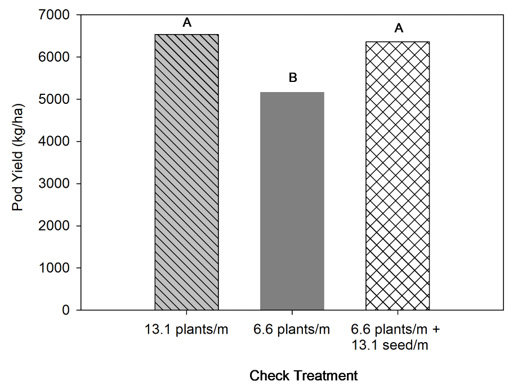
Figure 1. Mean peanut pod yield influenced by three check treatments, pooled over years (Tifton, GA 2017-2019). Means with the same letters denote no differences using pairwise t-tests (α=0.10).
Since the checks caused an unbalanced design, removing them from the statistical model allowed the remaining treatments to be analyzed as a two-factor factorial for the variables of replant method, gap presence, and their interaction. For pod yield, the interaction of replant method × gap was right at the P ≤ 0.10 level when rounded down (Table 2); therefore, the data was analyzed using the interaction values with pairwise t-tests at α = 0.10. This allowed a more detailed assessment of when a specific percentage of missing row (gap length + frequency) may benefit from replanting only in the missing gap segment(s) vs when replanting the entire row was necessary for the best output.
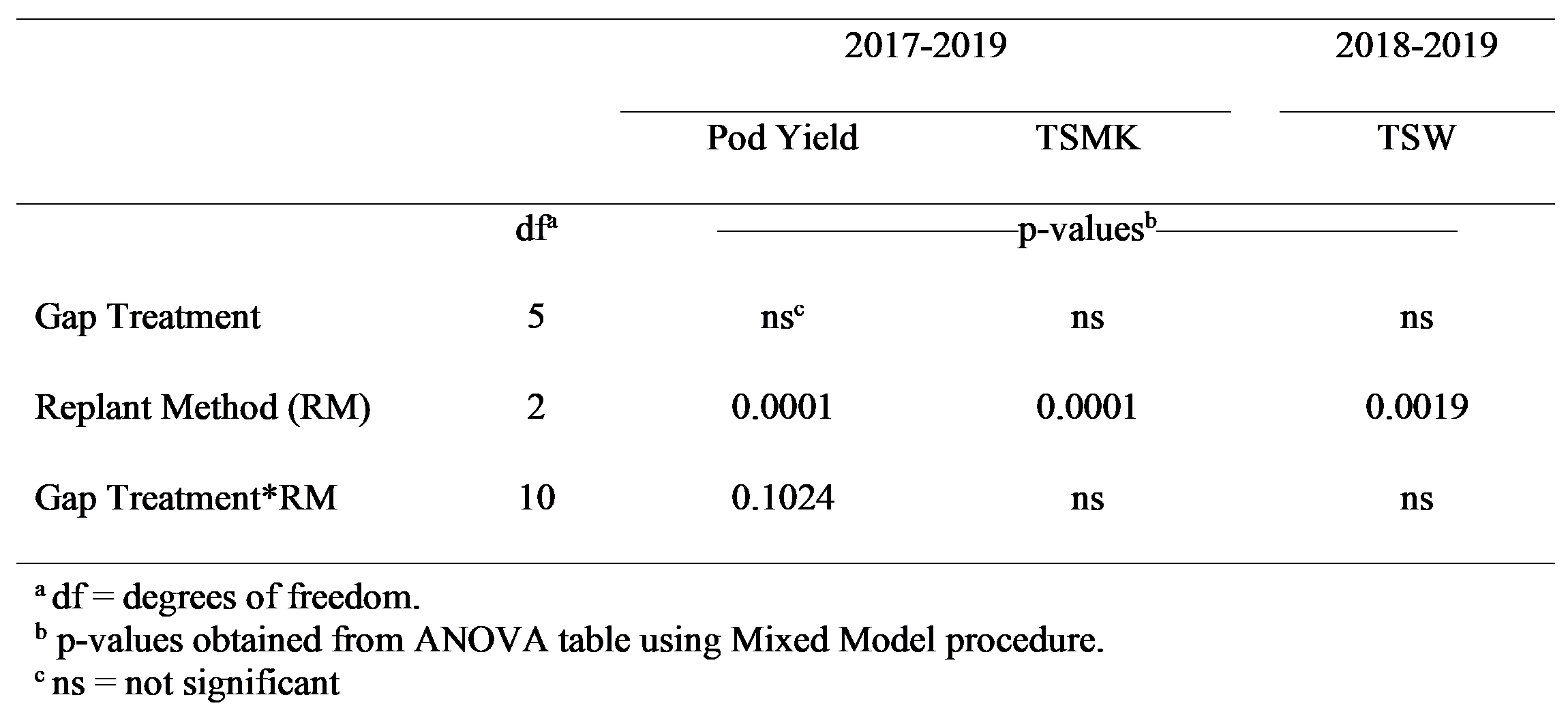
Analysis of variance probability values for pod yield, grade (total sound mature kernels [TSMK]) and incidence of Tomato spotted wilt (TSW) determined for Gap Treatment, Replant Method, and their interaction from 2017-2019 Tifton, GA.
Peanut rows with gaps of 61 cm
When a 61 cm gap was introduced, there was no yield increase by replanting only in the gap compared to leaving the stand alone (Fig. 2). It did not matter whether this gap occurred once (6% of row missing) or twice (12% of row missing) in the row. This demonstrates the ability of the initially planted peanut to compensate for the missing section(s) of the row. However, the “full-row” replant improved yield (14-23%) in both 61 cm gap length scenarios compared to not replanting. Final plant stands were 5.7-6.0 plants/m with “no replant” and 5.8-6.7 plants/m with a “gap only” replant, whereas respective stands increased to 14.2-14.5 plants/m in the “full-row” replanting. Increasing the total plant population of the entire plot, plus advancing the maturity based on the delayed maturity profile (since a larger proportion of the plants in the row were less mature, causing this treatment to project a later dig date than the other two treatments that were predominantly plants from the initial planting) were the largest contributing factors to this increase in yield. This observation warrants future research about the potential to increase yield through replanting to increase plant population and spread out the maturity window to reduce the risks associated with digging late, which can often occur during harvest season when rain events or extremely dry conditions in non-irrigated management may delay digging beyond optimum.
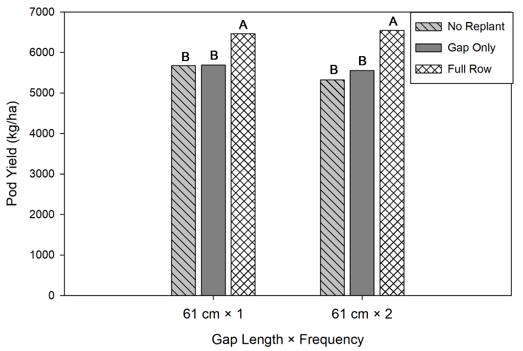
Figure 2. Mean peanut pod yield, influenced by replant method and 61 cm gap frequency, pooled over year (Tifton, GA 2017-2019). Means with the same letters denote no differences using pairwise t-tests (α=0.10).
Peanut rows with gaps of 122 cm
When the length of the gap doubled to 122 cm, replanting only in the gap did not improve yield when only 12% of the row was missing (one gap segment per row) (Fig. 3). However, when the gap segment occurred twice in the row (representing an absence of plants for around 23% of the row), there was a 12% yield improvement by replanting these gaps compared to not replanting. There was still a greater yield benefit (29-34% increase) by using a “full-row” replant method over not replanting, for reasons described in the previous subsection. Final plant stands using these treatments were 5.5-6.2 plants/m with “no replant”, 6.2-6.8 plants/m with a “gap only” replant, and 12.7-13.4 plants/m in the “full-row” replanting.
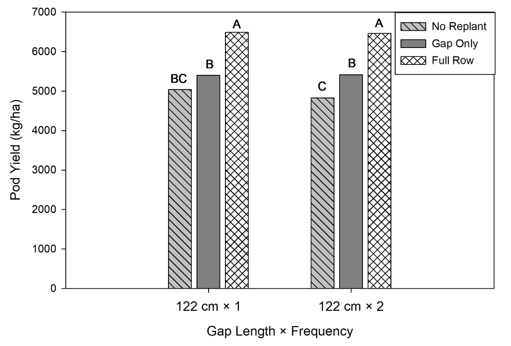
Figure 3. Mean peanut pod yield, influenced by replant method and 122 cm gap frequency, pooled over year (Tifton, GA 2017-2019). Means with the same letters denote no differences using pairwise t-tests (α=0.10).
Longer segments of missing row occur less frequently than shorter gaps and can be caused by a number of different reasons. Some of these may be related to presence of certain diseases such as crown rot (Aspergillus niger) and/or southern stem rot (Agroathelia rolfsii Sacc.), but can also be associated with other pests like rooting of seeds/seedlings by wild pigs/hogs/boars (Sus scrofa L.) (Boyce et al., 2020; Smith, 2025), feeding of emerging seedlings by deer (Odocoileus virginaianus) (Farris, 2003; Lyon and Scanlon, 1985), pH/fertility issues (Davis-Carter et al., 1991), etc.
Peanut rows with gaps of 183 cm
Peanut rows with 183 cm gap length had final plant stands of 5.3-6.1 plants/m with “no replant”, 7.0-7.2 plants/m using a “gap only” replant, and increased to 14.2-14.4 plants/m with a “full row” replant. When this longer gap segment occurred once in each row (18% missing row), yield was subsequently boosted by 17% by replanting only the gap compared to not replanting, and by 38% using a “full-row” replant (Fig. 4). In the case of two missing segments of row measuring 183 cm each (representing 35% missing row), replanting only the gap resulted in a 29% yield increase and replanting the entire row improved yield by 61% compared to not replanting. This emphasizes that the peanut plant’s ability to compensate for missing sections of row is limited and rapid yield losses can be experienced once the threshold for compensation is exceeded. The results in this experiment demonstrate yield improvement when 18% or more of the row is missing, whether in one long gap or multiple shorter gaps, therefore the threshold for compensation is a function of both the gap length and the total percentage of missing row.
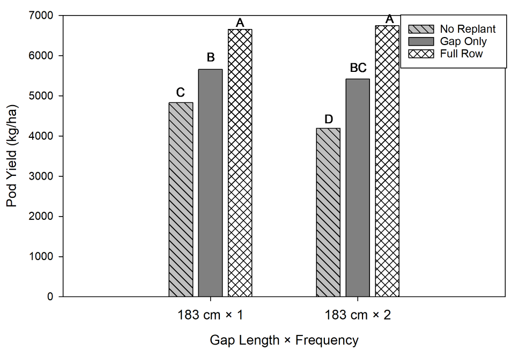
Figure 4. Mean peanut pod yield, influenced by replant method and 183 cm gap frequency, pooled over year (Tifton, GA 2017-2019). Means with the same letters denote no differences using pairwise t-tests (α=0.10).
Economic assessment
A “full-row” replant at 13.1/seed m requires approximately 100 kg seed/ha (based on Georgia-06G, but is cultivar-dependent since seed size varies). A simplified economic analysis approximates this amount of seed to cost around $186.79/ha, and an additional fuel cost of $56.79/ha (UGA-AAE, 2019). The yield needed to offset the seed and fuel cost is 567 kg/ha based on an average contract price of $0.43/kg peanut pods in 2019 (USDA-NASS, 2020). This yield improvement was obtainable at all gap lengths when a “full-row” replant was applied. The “full-row” replant strategy would be an effective strategy to boost production when varying gap lengths in the row occur in already sparse or sub-optimal uniform plant stands. Costs associated with a “gap-only” replant would be substantially less, but would depend on the location, length, and frequency of gaps within a field.
Grade: Total Sound Mature Kernels (%TSMK)
No difference in TSMK was observed between the 6.6 plants/m or 13.1 plants/m check populations. When compared in a factorial combination with the check plots removed, grade was influenced by the replant method independently and had no interaction with the gap variable (Table 2). The “full-row” replanting (74.8%) had greater TSMK than the “noreplant” (73.3%) and “gap-only” replanting (73.0%). The later digging triggered as a result of a greater proportion of younger plants from replanting allowed the pods to mature for a longer period. A similar trend was observed in another study where different digging dates of supplementally replanted peanuts were tested (Tubbs and Monfort, 2022b). Tracking maturity progression is critical when replanting peanut as they typically takes longer than the peanuts planted at the same time. Sacrificing a few overmature pods from the initial planting in order to progress a greater proportion of less-mature pods will usually be a worthwhile management strategy when the vegetation of the plant is healthy enough to continue growing and not sacrifice additional pods due to weakened peg strength.
Incidence of Tomato Spotted Wilt (%TSW)
There were differences among the checks for TSW incidence (P=0.0287). The 6.6 plants/m stand had 41% incidence, while the 13.1 plants/m stand resulted in 26% incidence. When the 6.6 plants/m stand was replanted with a full-row seeding rate, incidence was reduced to 30%, which was not significantly different from the 13.1 plants/m stand. This indicates that replanting in a reduced risk window (Kemerait et al., 2026) to increase the total plant population is a valid way to mitigate TSW incidence if early flights of Western flower thrips (Frankliniella occidentalis) and Tobacco thrips (Frankliniella fusca) are heavy and feeding injury on young plants by viruliferous thrips is severe.
The check plots were removed to compare the replant treatment variables in factorial combinations. The TSW incidence was influenced by replant method independently and no interaction with the gap variable (Table 2). Incidence was least in the “full-row” replant treatment (26%), followed by the “gap only” treatment (33%), and most where there was “no replant” (35%). The decrease in pathogen observation further suggests that a “full-row” supplemental replant into a non-uniform or suboptimal plant population helps mitigate TSW incidence. Culbreath and Srinivasan (2011) reported that increasing plant population does not necessarily reduce the infection rate, rather the increased population decreases the percentage of plants that are infected. Additionally, infected plants often cease normal growth, and the neighboring healthy plants will overgrow the dwarfed plants (or cannibalize the diseased plant altogether), making the dead or shrunken plants less visible during these visual ratings. Since the initial planting was during the window of greatest TSW risk while the replanted plants were during a time of reduced TSW risk (Kemerait et al., 2026), incorporating replanting in the gap increased the proportion of plants with reduced risk by adding new plants in the reduced risk window. That proportion increased substantially with the addition of “full-row” replanting, causing a much larger percentage of plants to emerge under reduced risk of TSW incidence.
Furthermore, reduced TSW from both replant methods compared to the “noreplant” situation could be related to thrips feeding behavior. While not welldocumented, it is believed that thrips are attracted to areas with more bare soil exposure (Culbreath et al., 2003; Culbreath and Srinivasan, 2011). This can cause additional infection at gap edges, which would lead to greater incidence in plots where gaps are exposed and not replanted compared to where the gaps are filled with new plants several weeks after initial planting, reducing bare ground exposure time.
Other considerations
The overall objective of determining the optimal method of replanting peanut when varying gap lengths occur in sparse plant stands was divided into subobjectives. It should be noted that these results were based on a 91 cm row spacing in single row pattern. The results may differ in twin row pattern or at a different row spacing. While results may not be directly transferable in a different pattern or spacing, the information in terms of percentage of missing row still provides a useful starting point. The subobjectives were met or not met in the following ways:
- Differences exist between the recommended plant population of 13.1 plants/m and a half-population of 6.6 plants/m. The low population reduced yield by 21% and increased TSW by 15%. This warrants consideration of replanting.
- Supplementally replanting a reduced stand of 6.6 plants/m improved yield by 23% compared to leaving the stand alone. This also reduced TSW incidence by 11%. Both results are equivalent to achieving an initial stand of 13.1 plants/m.
- When gaps are present in a sub-optimal plant stand, replanting is beneficial if managed appropriately. a. Replanting only in the gap was beneficial compared to not replanting in some cases when a minimal threshold of missing row was reached (see 4&5 below).
b. Replanting the entire row was always beneficial, albeit these plants were left in the field for a longer period of time than the other treatments, allowing a larger proportion of pods to reach a greater maturity progression, resulting in greater yield and TSMK.
4&5. When replanting only the gaps in a row, a minimum of 18% of the row had to be devoid of plants before a yield increase was observed. Gaps also had to be at least 122 cm in length along with the total missing proportion of row for “gap only” replanting to be justified over not replanting. However, replanting the entire row was superior regardless of the gap length or proportion of missing row in terms of yield, grade, and TSW incidence.
Yield reductions in this trial are attributed to two factors: the sparse stand and excessive missing row segments. The “gap-only” replant could prove beneficial for growers that may not have the additional seed or time needed for the “full-row” replant. In such a scenario, “gap-only” can be beneficial over no-replant at all. Improvements in planting technology may also make it possible to reduce replant costs associated with trips across a field, making a “gap-only” replant scenario a less costly endeavour compared to a “full-row” replant situation. The efficient process of only replanting needed sections of a field would allow the farmer to cover more acreage more quickly. Timing of a replant decision is highly important and should not be more than 3 weeks after initial planting (Sarver, 2014). Hence, a “gaponly” replant has considerable merit when time is of the essence or seed is in short supply.
The later digging date for the “full-row” treatment allowed the kernels of the replanted plants to mature longer and continue to fill the pods. Even if some initial pods become overmature and are lost to weakened pegs or sprouting on the vine, the gain from advancing maturity of additional replanted plants more than offset any potential losses in this trial. The reduction in observed TSW symptomology demonstrated the importance of uniform and optimum plant population when managing this important pathogen.
There were no differences in yield between the “noreplant” and “gap-only” treatments when the gap lengths were minimal (no more than 12% of row missing). However, the “gap-only” method improved yield over the “no-replant” treatment when the cumulative length of missing row was 18% or greater, whether gap lengths were consecutive or non-consecutive. This indicates that the trigger point for the need to replant gaps in a field occurs somewhere between 12-18% of missing row when individual gap length is 122 cm or greater. Additional research is needed to determine if a greater frequency of smaller gaps might also reduce yield similarly to fewer large gaps in equal proportion of missing row percentage.
The 13% yield reduction when a 183 cm gap that occurred twice compared to a 183 cm gap that occurred once emphasizes the limitation of the ability for the peanut plant to compensate for segments of missing row up to a certain amount, and precipitous yield loss can occur when the peanut can no longer adequately compensate. However, when comparing the gaps that occur either once or twice at the shorter gap intervals, the peanut plant could compensate for up to 12% of missing row, whether it was consecutive (one x 122 cm long gap) or non-consecutive (two x 61 cm long gaps). The ability of the peanut plant to compensate is an important component in determining when replanting is needed.
Further research is needed to improve the practicality of “gap-only” replant methodologies. Future research may allow precision planting using active light sensors or aerial imaging from a drone or satellite to identify portions of a field that meet the minimum requirements for replanting, allowing efficient identification and implementation of replanting. Research is also still needed to identify the optimum seeding rate for replanting to potentially further reduce the cost to producers and/or improve production.
Acknowledgements
This research was supported by the Georgia Crop Improvement Association and Georgia Seed Development Commission through donation of peanut seed, along with the Georgia Peanut Commission and the National Peanut Board for funding the project. The authors would like to thank Zach Cromer, Hayden Godwin, Ana Julia Azevedo, Hunter Hayes, Dr. Edzard van Santen, and staff of the UGA Lang-Rigdon farm for technical assistance. This research was associated with the objectives of Federal CRIS GEO00273.
Literature Cited
Bean B., and Duncan R.. 2024. Wheat Replanting Considerations. Texas AgriLife Ext. Serv. Available at https://oaktrust.library.tamu.edu/server/api/core/bitstreams/8a8d3157-6436-497c-843e-f39a5ca7a334/content (verified 30 June 2026).
Boyce C.M., VerCauteren K.C., and Beasley J.C.. 2020. Timing and Extent of Crop Damage by Wild Pigs (Sus scrofa Linnaeus) to Corn and Peanut Fields. Crop Protection 133. doi: 10.1016/j.cropro.2020.105131.
Branch W.D., Baldwin J.A., and Culbreath A.K.. 2003. Genotype × Seeding Rate Interaction among TSWV-Resistant, Runner-Type Peanut Cultivars. Peanut Sci. 30(2): 108-111. doi: 10.3146/pnut.30.2.0009.
Branch W.D. 2007. Registration of ‘Georgia‐06G’ peanut. J. Plant Reg. 1:120. doi: 10.3198/jpr2006.12.0812crc.
Campbell S. 2018. Replanting Decisions for Winter Wheat. Great Bend Tribune [Online] Available at https://www.gbtribune.com/news/business/replanting-decisions-winter-wheat/ (verified 30 June 2026).
Culbreath A.K., Todd J.W., Brown S.L.. 2003. Epidemiology and Management of Tomato Spotted Wilt in Peanut. Ann. Rev. Phytopathology 41: 53-75. doi: 10.1146/annurev.phyto.41.052002.095522.
Culbreath A.K., and Srinivasan R.. 2011. Epidemiology of Spotted Wilt Disease of Peanut Caused by Tomato Spotted Wilt Virus in the Southeastern U.S. Virus Res. 159(2): 101109. doi: 10.1016/j.virusres.2011.04.014.
Davis-Carter J.G., Parker M.B., and Gaines T.P.. 1991. Interaction of Soil Zinc, Calcium, and pH with Zinc Toxicity in Peanuts. Pp. 339-347. In Wright R.J., Baligar V.C., and Murrmann R.P. (Eds.) Plant-Soil Interactions at Low pH. Developments in Plant and Soil Sciences, vol. 45. Springer, Dordrecht. doi: 10.1007/978-94-011-3438-5_39.
Farris R.L. 2003. Time of Removal of Crownbeard (Verbesina encelioides) from Peanuts (Arachis hypogaea) and Influence of Crownbeard Densities on Peanut. M.S. Thesis. Oklahoma State University, Stillwater, OK. https://openresearch.okstate.edu/server/api/core/bitstreams/b3b9395d-f31f-4adb-8471-01051a8a4646/content (verified 30 June 2026).
Gaspar A.P., and Conley S.P.. 2015. Responses of Canopy Reflectance, Light Interception, and Soybean Seed Yield to Replanting Suboptimal Stands. Crop Sci. 55:377-385. doi: 10.2135/cropsci2014.03.0200.
Kemerait R., Culbreath A., Brenneman T., Tubbs S., Srinivasan R., Abney M., Monfort S., Pilon C., Bag S., Brown N., LaForest J., Oliveira C., Prostko E., Tillman B., Dufault N., Small I., Grabau Z., Chen C., Jacobson A., Balkcom K., Strayer-Scherer A., Graham S., Zurweller B., Anco D., Langston D., and Lux L.. 2026. Peanut Rx: Minimizing Diseases of Peanut in the Southeastern United States. Available Online at https://peanutrx.ort/about.html (verified 30 June 2026).
Liu W., Tollenaar M., Stwear G., and Deen W.. 2004. Response of Corn Grain Yield to Spatial and Temporal Variability in Emergence. Crop Sci. 44:847-854.
Lyon L.A., and Scanlon P.F.. 1985. Evaluating reports of Deer Damage to Crops: Implications for Wildlife Research and Management Programs. Eastern Wildlife Damage Control Conf.: 2nd 51. Available at: https://digitalcommons.unl.edu/ewdcc2/51 (verified 30 June 2026).
Porter W. 2021. Irrigation Reference Guide – Corn, Cotton, Peanuts, and Soybean. Univ. of Georgia Coop. Ext., Athens, GA. Circ. 1189. Available at https://fieldreport.caes.uga.edu/wp-content/uploads/2025/08/C-1189_5.pdf (verified 21 August 2026).
Robinson A.P., and Conley S.P.. 2007. Thin Soybean Stands: Should I Replant, Fill In, or Leave Them Alone? Coop. Ext. Serv. SPS-104-W. Purdue Univ., West Lafayette, IN. Available at: https://www.extension.purdue.edu/extmedia/SPS/SPS-104-W.pdf (verified 30 June 2026).
Sarver J.M. 2014. Evaluating Plant Populations and Replant Considerations Across Multiple peanut (Arachis hypogaea L.) Production Methods. Ph.D. dissertation. University of Georgia, Athens, GA. https://openscholar.uga.edu/record/15585?ln=en&v=pdf (verified 30 June 2026).
Sarver J.M., Tubbs R.S., Beasley J.P., Culbreath A.K., Grey T.L., Rowland D.L., and Smith N.B . 2016. Plant Population and Replant Method Effects on Peanut Seeded in Single Rows. Peanut Sci. 43(2): 126-132. doi: 10.3146/PS16-13.1.
Smith J.L. 2025. Quantifying and Mitigating Wild Pig (Sus scrofa) Damage to Agricultural Crops. Ph.D. dissertation. University of Georgia, Athens, GA. https://openscholar.uga.edu/record/27804?ln=en&v=pdf (verified 30 June 2026).
Srinivasan R., Abney M.R., Culbreath A.K., Kemerait R.C., Tubbs R.S., Monfort W.S., and Pappu H.R.. 2017. Three Decades of Managing Tomato Spotted Wilt Virus in Peanut in Southeastern United States. Virus Res. 241: 203-212. doi: 10.1016/j.virusres.2017.05.016.
Steel R.G.D., and Torrie J.H.. 1960. Principles and Procedures of StatisticsMcGraw-HillNew York, NY. 481 p.
Terry R.M., Dobbels T., Loux M.M., Thomison P.R., and Johnson W.G.. 2012. Corn Replant Situations: Herbicide Options and the Effect of Replanting into Partial Corn Stands. Weed Tech. 26(03): 432-437. doi: 10.1614/wt-d-11-00158.1.
Tubbs R.S., and Monfort W.S.. 2022a. Planting. pp. 72-75. In Peanut Production Guide. Univ. of Georgia Coop. Ext., Athens, GA. Bull. 1146. Available at https://fieldreport.caes.uga.edu/publications/B1146/peanut-production-field-guide/ (verified 30 June 2026).
Tubbs R.S., and Monfort W.S.. 2022b. Timing of Termination for Supplemental Replanted Peanut to Maximize Yield and Grade. Peanut Sci. 49(1):41-48. doi: 10.3146/0095-3679-491-PS21-13.
Tukey JW 1949. Comparing Individual Means in the Analysis of Variance. Biometrics 5:99-114. doi: 10.2307/3001913.
USDA-AMS. 2019. Farmer’s stock inspection instructions. Agricultural Marketing Service, Fruit and Vegetable Division. Washington, DC.
USDA-NASS. 2020. National Agricultural Statistics Service Quick Stats Peanuts Price Received. Available at http://quickstats.nass.usda.gov/ (verified 30 June 2026).
UGA-AAE. 2019. University of Georgia Dept. of Agric. and Applied Economics, 2019 Irrigated Peanut. In UGA Historical Budgets. The University of Georgia, Athens, GA. https://agecon.uga.edu/extension/budgets/historical-budgets.html (verified 30 June 2026).
UGA Peanut Team. 2022. Peanut Production Guide. Univ. of Georgia Coop. Exten., Athens, GA. Bull. 1146. Available at https://fieldreport.caes.uga.edu/wp-content/uploads/2025/08/B-1146_2.pdf (verified 30 June 2026).
Vasilas B.L., Pepper G.E., and Jacob M.A.. 1990. Stand Reductions, Replanting, and Offset Row Effects on Soybean Yield. J. Production Agric. 3(1):120-123. doi: 10.2134/jpa1990.0120.
Whigham K., Farnham D., Lundvall J., and Tranel D.. 2000. Soybean Replant Decisions. Iowa State University, University Ext. PM-1851. Available at https://shop.iastate.edu/extension/farm-environment/crops-and-soils/agronomic-crops/pm1851.html (verified 30 June 2026).
Williams E.J., and Drexler J. S.. 1981. A Non-destructive Method for Determining Pod Maturity. Peanut Sci. 8:134-141. doi: 10.3146/i0095-3679-8-2-15.
Notes
- First and second authors: Graduate Student, and Professor, Dept. of Crop and Soil Sciences, University of Georgia, Tifton, GA 31793; Third and fourth authors: Professor, and Professor, Dept. of Plant Pathology, University of Georgia, Tifton, GA 31793. [^] Corresponding author’s E-mail: tubbs@uga.edu