


Introduction
Hammons (1953) first described the occurrence and inheritance of a Cup-Leaf mutant induced by X-rays from seed of the ‘NC 4’ -18.5kR virginia-type peanut (Arachis hypogaea L. ssp. hypogaea var. hypogaea) cultivar (Gregory, 1955). Hammons also proposed the gene symbol, cu, for the X-ray induced cup mutant, and he found that it was inherited as a single recessive gene in the X2 and X2:3 families. However, the X-ray induced cup mutant expressed an array (1-5) of different grades ranging from 1 and 2 = very cup to 4-5 = slightly cup (Hammons, 1968). It also exhibited anomalous inherited behavior with different segregation ratios when crossed to other macro-mutants in these studies (Loesch and Hammons, 1968).
Sterility in peanut has previously been reported for brachytic plants found among F2 populations resulting from crosses between the two subspecies hypogaea x fastigiata (Ashri 1968, Coffelt and Hammons 1972, Hull 1937). Branch et al., (2016) also found similar sterile brachytic plants within F2 populations derived from crossing A. hypogaea ssp. hypogaea cv. ‘Georgia-11J (Branch, 2012) x A. hypogaea ssp. fastigiata cv. ‘Georgia Valencia’ (Branch, 2001). Sterile dwarf plants were also found within different F2 populations within ssp. hypogaea x hypogaea crosses (Branch, et al. 2016).
Sterility always occurs when crossing wild diploid (2n=20) species with a cultivated tetraploid (2n = 40). The sterile F1 triploid (2n = 30) is then treated with colchicine to double the chromosome number to 2n = 60 to restore fertility. The sterility within triploid plants is because of uneven pairing of chromosomes; however, it has not been found within F1 plants from tetraploid x tetraploid cross combinations.
During 2021, a single plant selection was found with very distinct cup-leaf characteristics within the advanced Georgia runner-type peanut breeding line, GA 142509 (Fig. 1). It was designated as GA 142509-1 New Cup-Leaf after three generations of selfing during this genetic study. Virginia and runner U.S. market-type each belong to Arachis hypogaea L. subspecies hypogaea var. hypogaea classification (Hammons, 1973). The objective of this study was to determine the inheritance of this new runner-type Cup-Leaf mutant and compare it with the previously X-ray induced virginia-type Cup-Leaf mutant.
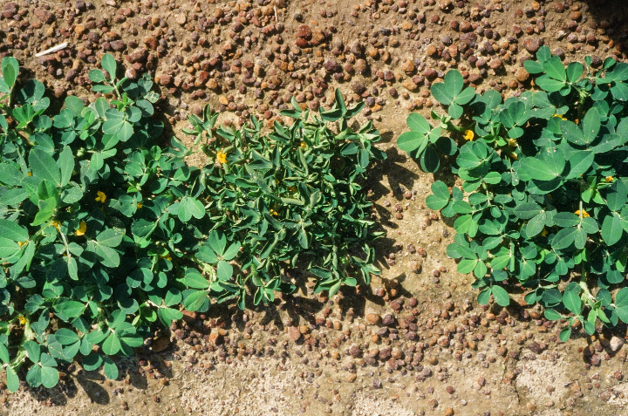
Figure 1. A “New Cup-Leaf” plant found within the advanced Georgia runner-type peanut breeding line, GA 142509.
MATERIAL AND METHODS
Seed of the older X-ray-induced Cup-Leaf mutant were obtained from N. C. State University peanut breeding program. During the fall and winter 2022-23, full-diallel crosses were made in the greenhouse at the University of Georgia, Coastal Plain Experiment Station between the X-ray NC 4 Slight Cup-Leaf, GA 142509-1 New Cup-Leaf, and Normal-Leaf GA 142509.
In 2023, F1 seed were space-planted 121.9 cm apart in single-row field nursery plots at the Gibbs research farm near the University of Georgia, Coastal Plain Experiment Station, Tifton Campus. In 2024 and 2025, F1:2 and F2:3 seed were space-planted 30.5 cm apart in two-row plots with variable length depending upon number of seed x 1.8 m wide beds, respectively.
The soil-type was a Tifton loamy sand (fine-loamy, siliceous, thermic, Plinthic Kandiudult). Recommended cultural practices with irrigation were followed throughout both growing seasons. Individual plants were harvested near optimum maturity based upon days after planting and above-ground plant appearance. After harvest peanut pods were dried with forced warm air to approximately 6% seed moisture content before weighing and shelling.
Phenotypic classification was based upon individual plants prior to harvest and after digging. Segregation data was analyzed by chi-square analysis for goodness-of-fit (P≤0.05) to expected genetic ratios (Strickberger, 1968).
RESULTS AND DISCUSSION
F1 hybrids resulting from the full-diallel crossing scheme are presented in Figure 2. These F1 results show that both Cup-Leaf mutants (X-ray NC 4 and GA 142509-1) were found to be recessively inherited. However, several cross combinations resulted in both fertile and sterile F1 plants, specifically when GA 142509 Normal-Leaf was used as the female parent x the two Cup-Leaf mutants as male parents. Likewise, sterility was found in F1 plants from the X-ray NC 4 Cup-Leaf (♀) x GA 142509-1 New Cup-Leaf (♂) cross combination. The sterility results were quite surprising and unexpected. These sterile F1 plants exhibited typical above-ground appearance, but upon digging and inverting essentially very few if any pods could be found, and only aborted seed were found in the pod. No differences were also found among stained pollen grains from all three parents.
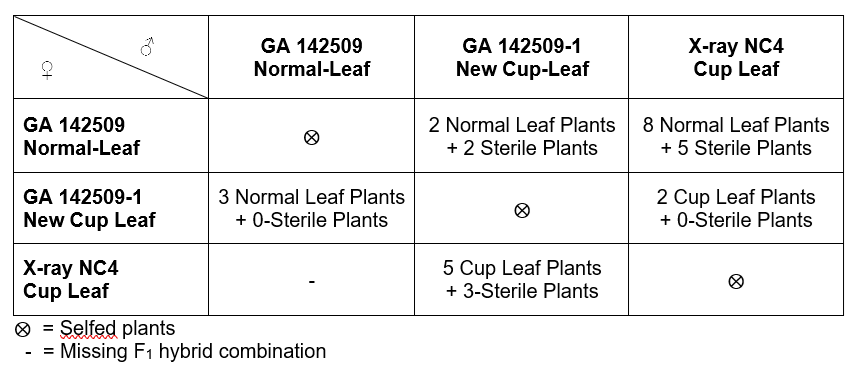
Figure 2. Number of F1 hybrid plants derived from a complete diallel crossing scheme involving two different sources of Cup-Leaf mutants and the Normal-Leaf parental breeding line, GA 142509.
During the 2024 growing season, F2 plant segregation was determined from the 2023 fertile F1 hybrids. The two cross combinations from GA 142509-1 (new cup) x GA 142509 (normal) and GA 142509 (normal) x X-ray NC 4 (slight cup) both resulted in an acceptable fit for a 54 Normal to 10 Cup-Leaf genetic ratio (Table 1). Total, summed, and homogeneity chi-square were likewise acceptable with probability values greater than P≥0.05.

F2 plant segregation for number of normal and cup-leaf plants among two peanut cross combinations.
F2 plant segregation was also determined for the number of normal fertile vs normal sterile plants within the GA 142509 normal x X-ray NC4 slight cup cross combination. Again similar to the F1 plants, there was a strong association with sterility only in the normal-leaf F2 plants. The F2 segregation was found acceptable for a 15 fertile to 1 sterile genetic ratio (Table 2). This suggest that 2 recessive genes controlling the sterility were found in this study.

F2 plant segregation for fertile and sterile plants among the peanut cross combination GA 142509 normal x X-ray NC4 slight cup.
Likewise, F2 plant segregation was determined for very cup vs slight cup from the X-ray NC4 slight cup x GA 142509-1 very cup cross combination. The F2 chi-square analysis was found acceptable for a 3 very cup to 1 slight cup (Table 3). This suggests that new very cup is dominant to the old slight cup-leaf and controlled by only one gene. However, the F2 population from this cross combination was quite small and should only be considered preliminary data.

F2 plant segregation for very cup and slight cup plants among the peanut cross combination (X-ray NC4 slight cup x GA 142509-1 new cup).
F3 progeny row segregation from normal leaf F2 plants showed an acceptable fit to an 8 segregating for cup versus non-cup to 7 non-segregating ratios for both cross combinations (Table 4). Likewise, the F2 cup-leaf plants bred true-to-type in the F3 generation. However, F3 chi-square segregation for cup vs non-cup was not found acceptable (P<0.05) for the expected 44 segregating : 10 non-segregating from the expected 54:10 F2 ratio. This data suggests that any 2 of 3 duplicate recessive genes control the Cup-Leaf trait found in both the X-ray induced virginia-type NC 4 cultivar and the unrelated runner-type Georgia breeding line, GA 142509-1. The gene symbols (cu1, cu2, and cu3) are proposed for the three recessive genes controlling the older, slight cup-leaf and the new, very cup-leaf trait recently found in the cultivated peanut. Previously, this same 54:10 genetic ratio was also reported in peanut for the inheritance of the one-seeded pod trait (Branch, 2008). This one-seeded pod trait could be yet another example of partial or semi-sterility in peanut.
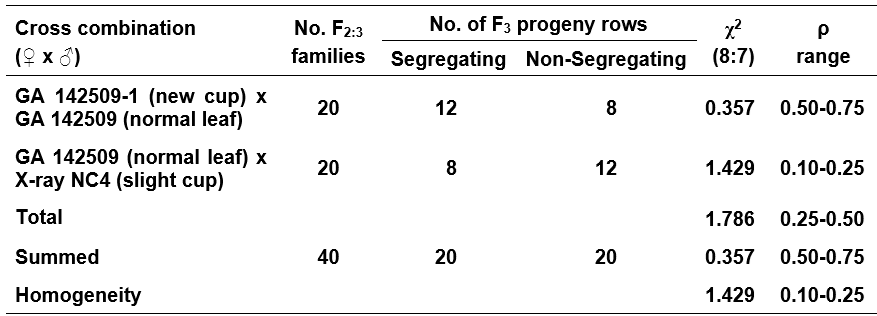
F3 progeny row segregation from F2 normal-leaf plants resulting from GA 142509-1 (new cup) x GA 142509 (normal-leaf) and GA 142509 (normal-leaf) x X-ray NC4 (slight cup) cross combinations.
The F3 cross populations from GA 142509 normal-leaf x NC4 Irradiated Cup-Leaf had several more sterile plants than the F3 cross population from GA 142509-1 new cup-leaf mutant x GA 142509 normal-leaf. Once again as in the F1 and F2 population the sterility appears to be tightly linked to only the normal-leaf plants.
Pollen from sterile F3 plants showed 80% aborted (collapsed irregular shaped) pollen grains vs 20% normal, viable pollen. Whereas pollen from different fertile plants were found to have 84% viable pollen vs 16% aborted pollen (Fig. 3). The sterility appeared only in some F1 plants and not all, it could be caused by an extra chromosomal fragment that is randomly transmitted during meiosis causing an abnormal ploidy level difference. In conclusion, it appears that the sterility discovered in the F1, F2, and F3 cross populations might be attributed to male nuclear genes and not cytoplasmic male sterility (Allard, 1960).
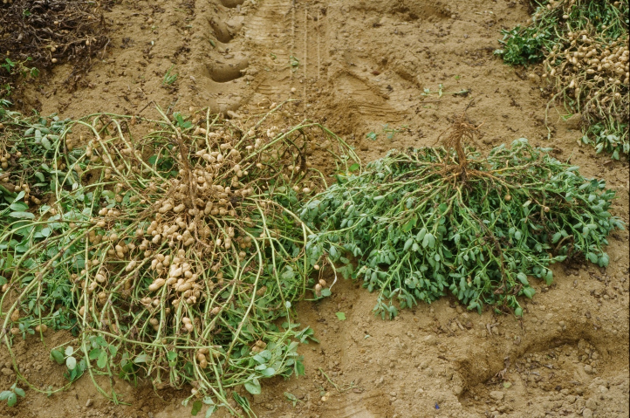
Figure 3. Fertile plant (left) and sterile plant (right) found in the F1, F2, and F3 cross populations.
Acknowledgements
The valuable contribution and helpful manuscript review by Dr. Wayne W. Hanna for determining the pollen viability during this study is gratefully acknowledged.
Literature Cited
Allard R. W. 1960. Chap. 20. Systems of pollination control of crop plants. pp. 234-251 In: Principles of Plant Breeding. John Wiley & Sons, New York, NY.
Ashri A. 1968. Morphology and inheritance of sterile brachytic dwarfs in peanuts. Arachis hypogaea. Crop Sci. 8:413-415.
Branch W. D. 2001. Registration of ‘Georgia Valencia’ peanut. Crop Sci. 41: 2002-2003.
Branch W. D. 2008. Inheritance of a one-seeded pod trait in peanut. J. Hered. 99: 221-222.
Branch W. D. 2012. Registration of ‘Georgia-11J’ peanut. J. Plant Reg. 6: 281-283.
Branch W. D., Clevenger J. P., and Schwartz B. M.. 2016. Inheritance of sterile brachytic and sterile dwarf plants in peanut. Peanut Sci. 43: 116-118.
Coffelt T. A. and Hammons R. O.. 1972. Inheritance of sterile brachytic in an infraspecific cross of Arachis hypogaea L. Crop Sci. 12: 82-84.
Gregory W. C. 1955. X-ray breeding of peanuts (Arachis hypogaea L.). Agron. J. 47: 396-399.
Hammons R. O. 1953. Arachis hypogaea. Behavior of the induced mutant, cup. J. Elisha Mitchell Sci. Soc. 69: 84-85.
Hammons R. O. 1968. Frequency, grade variability, and yield response of the cup mutant (NC 4-18.5kR). pp. 120-122. In: Gregory W. C. (ed) A radiation breeding experiment with peanuts. Rad. Bot. 8: 81-147.
Hammons R. O. 1973. Genetics of Arachis hypogaea. pp. 135-173 In: Peanuts-Culture and Uses, Am. Peanut Res. Educ. Assoc., Stillwater, OK.
Hull F. H. 1937. Inheritance of rest period of seeds and certain other characteristics in the peanut. Univ. Florida Agr. Exp. Stn. Tech Bull. 314.
Loesch Jr., P.J. and Hammons R.O.. 1968. Chap. 3. Inheritance of macro-mutants (NC4-18.5 kR). pp 94-108 In: Gregory W.C. (ed) A radiation breeding experiment in peanuts. Rad. Botany 8: 81-147.
Strickberger M. W. 1968. Chap. 8. Probability and statistical testing. pp. 126-152. In Genetics. The Macmillian Co., New York, NY.
Notes
- Professor, Dept. of Crop & Soil Sci., University of Georgia, Coastal Plain Experiment Station, Tifton, GA 31793 [^]
- Assistant Professor, Dept. of Crop and Soil Sci., University of Georgia, Coastal Plain Experiment Station, Tifton, GA 31793 [^]
- Associate Professor, Dept. of Crop and Soil Sciences, North Carolina State Univ. Raleigh, NC 27607 [^] Corresponding author: wdbranch@uga.edu