

Introduction
Peanut (Arachis hypogaea L.) is a crop with challenging weed management issues. First, most peanut cultivars grown in the U.S. require a 140 to 160 d growing season depending on cultivar and geographical region (Henning et al., 1982; Wilcut et al., 1995; Leon et al., 2025). Soil-applied herbicides may not provide season-long weed control and this can result in mid- to late-season weed problems. Secondly, peanut has a shorter growth habit, a shallow canopy, and depending on weather conditions, may be slow to shade row middles allowing weeds to grow and become more competitive (Wilcut et al., 1995). Additionally, peanut fruit develops underground on pegs that originate from stems and grow along the soil surface. The shorter growth habit and pattern of fruit development limits cultivation to an early season control option (Brecke and Colvin, 1991; Wilcut et al., 1995;).
The repeated use of herbicides with the same or similar modes of action has led to herbicide resistance in weeds, most specifically Amaranthus species (Culpepper et al., 2006; Peterson, 1999; Van Gessel, 2001). This species, especially Palmer amaranth (Amaranthus palmeri S. Wats), is the most common and most troublesome weed in seven of the nine major peanut producing states in the U.S. (Van Wychen, 2022). Amaranthus species are very sensitive to resistance of ALS-inhibiting herbicides and possess characteristics such as high genetic variability, prolific seed production, and efficient pollen and seed distribution that predispose them to have herbicide resistant biotypes (Lovell et al., 1996). To reduce the risk and rate of development of herbicide-resistant weed populations, the use of soil-applied and POST herbicides with alternative sites of action is necessary (Shanner et al., 1997).
The premix of carfentrazone + pyroxasulfone (C + P) was labelled for use on peanut in the U.S. as Anthem Flex ® by the FMC Corporation (Anonymous, 2020a) in time for the 2020 growing season and adds another herbicide combination to the peanut weed control arsenal. It is labelled in peanut for early postemergence (EPOST) or postemergence (POST) use only. This premix will control ALS- (HRAC Group 2 herbicide) and glyphosate- (HRAC Group 9 herbicide) resistant Palmer amaranth, which is becoming more widespread across southwestern peanut producing areas (Anonymous, 2020b). Control of annual grasses such as Texas millet (Urochloa texana (Buckl.) R. Webster) is limited and full–season control of this annual grass in peanut typically requires the postemergence use of clethodim® (WSSA Group 1 herbicide) or other grass-inhibiting herbicides (Anonymous, 2020b).
Carfentrazone is an aryl triazolinone herbicide (Theodoridis et al., 1992) and the mode of action is the inhibition of protoporphyrinogen oxidase (Protox) (Dayan et al., 1997a; , 1997b) in the chlorophyll biosynthesis pathway that results in the accumulation of protoporphyrin IX (PPIX) in the cytosol (site of action Group 14) (Becerril et al., 1989; Sherman et al., 1991). PPIX is photoactive and involved in the light-dependent formation of singlet oxygen, which is responsible for plant death via membrane oxidation (Devine et al., 1993). It is a rapid-acting contact herbicide with little or no residual activity (Anonymous, 2017a) and susceptible weeds begin to desiccate within hours of treatment followed by necrosis and plant death within days.
Peanut injury from carfentrazone is typically expressed as leaf necrosis (burn) and this injury can be visible for 7 to 21 days after a carfentrazone application. Any new growth that appears after this time period is void of any type of injury. This leaf necrosis has been noted in other studies in Texas with carfentrazone (Dotray et al., 2010; Grichar et al., 2010).
Pyroxasulfone is a very long-chain fatty-acid biosynthesis inhibitor (Group 15), similar to chloroacetamide, oxyacetamide, and tetrazolinone herbicides and can be applied either preplant (PP), preplant incorporated (PPI), preemergence (PRE), or EPOST in corn (Zea mays L.), cotton (Gossypium hirsutum L.), peanut, soybean (Glycine max (L.) Merr.), and wheat (Triticum aestivum L.) (Hardwick, 2013; King and Garcia, 2008; Knezevic et al., 2009; Mangin et al., 2017; Tanetani et al., 2009; , 2011). Application timing is crop specific. In peanut, pyroxasulfone may be applied from ground cracking (CRACK) through beginning of the pod development stage (Anonymous, 2017b). It provides good to excellent control of many weeds in peanut including Amaranthus spp., Lolium spp, Urochloa spp., goosegrass (Eleusine indica L.), crowfootgrass (Dactyloctenium aegyptium L.), and Digitaria spp. (Cahoon et al., 2012; Koger et al., 2008; Nurse et al., 2011; Odero and Wright, 2013). Pyroxasulfone has low water solubility (3.49 mg/L at 20 C), and there is a strong correlation between soil binding, reduced herbicide dissipation, and increased soil organic matter content (Westra et al., 2014). Although pyroxasulfone has a similar weed control spectrum as S-metolachlor and dimethenamid-P, it has a higher specific activity allowing for use rates approximately eight times lower than dimethenamid-P (Curran and Lingenfelter, 2016).
Research has reported no injury from pyroxasulfone in corn (Mueller and Steckel, 2011) and Sikkema et al. (2008) reported that pyroxasulfone was safe on several sweet corn hybrids. In other crops pyroxasulfone was reported to injure pinto and small red Mexican beans (Phaseolus vulgaris L.) when applied PPI (Soltani et al., 2008). Cotton was less tolerant to pyroxasulfone PRE or POST than other chloroacetimde herbicides (Cahoon et al., 2015). In peanut, pyroxasulfone has good crop tolerance; however, pyroxasulfone applied PRE to peanut has been documented to cause early-season stunting but no yield loss (Eure et al., 2015).
To further understand peanut tolerance to carfentrazone + pyroxasulfone (C + P) and the potential for injury, field studies were conducted at two rates and three application timings in south Texas, the High Plains of Texas, and in the southwestern Oklahoma peanut growing regions to determine peanut variety response. The Anthem Flex® label (Anonymous, 2020a) states that this herbicide combination can be applied POST to peanuts from CRACK at the 1st leaf stage through the beginning of pod development. While PRE applications are currently not labled, this timing was included for information and future reference.
Materials and Methods
Peanut tolerance studies were conducted during the 2017 and 2018 growing seasons at the Texas A&M AgriLife Research site in south Texas near Yoakum, in 2017 near Lubbock at the Texas Tech Fiber and Biopolymer Research Institute (FBRI) and in 2018 at the Texas A&M AgriLife Research and Extension Center (TAMAREC). In Oklahoma, studies were conducted at the Oklahoma State University Caddo Research Station near Ft. Cobb in southwestern Oklahoma. Soils (Table 1) at Yoakum were a Tremona loamy fine sand
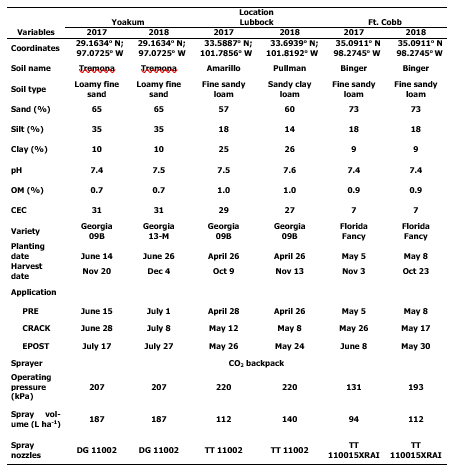
Variables associated with the study at each location.
(clayey. mixed, active, hyperthermic, Aquic Arenic Paleustalfs). Soils at the Lubbock location were a Amarillo fine sandy loam (fine-loamy, mixed, superactive, thermic Aridic Paleustalfs) at FBRI and a Pullman sandy clay loam (fine, mixed, superactive, thermic Torrertic Paleustolls) at TAMAREC. At Ft. Cobb, soils were a Binger fine sandy loam (fine-loamy, mixed, active, thermic Udic Rhodustalfs).
Treatments consisted of a factorial arrangement of two C + P rates (0.005 + 0.07 and 0.009 + 0.13 kg ai/ha) and three application timings, PRE, CRACK, and EPOST. The PRE applications were applied immediately after planting or up to 5 days after planting (DAP), the CRACK applications were made up to 21 DAP, and EPOST applications were made up to 34 DAP depending on location. Herbicides were applied using water as a carrier with a CO2-pressurized backpack sprayer. An untreated check was included in each study and each treatment was replicated three to four times depending on location. Other specifics of each study can be found in Table 1.
Peanut cultivars evaluated were those commonly grown in each production area. In south Texas Georgia-09B (Branch, 2010) was grown in 2017 while Georgia 13-M (Branch, 2014) was grown in 2018. At the Texas High Plains locations Georgia-09B was grown in both years while in Oklahoma the Virginia type peanut, Florida Fancy (Anonymous, 2008) was grown. Georgia-09B and Georgia 13-M have been grown in Texas for a number of years and are high-oleic and low-linoleic fatty acid composition with partial resistance to the Tomato Spotted Wilt Virus (TSWV) (Anomymous, 2024). Florida Fancy has a high-oleic fatty acid composition and has demonstrated very good yield potential and has among the best resistance to TSWV available in a Virginia markettype peanut (Tillman et al., 2015).
Each plot consisted of two rows spaced 97 cm apart and 7.6 m long at Yoakum. At both Lubbock locations plot size was 4 rows spaced 102 cm apart and 9.1 m long while at Ft. Cobb plots consisted of 4 rows spaced 76 cm apart and 7.6 m long. Traditional production practices were used to maximize peanut growth, development, and yield. Plots were maintained weed-free with the use of POST herbicides including clethodim for annual grasses and 2,4-DB for broadleaf weeds or hand-weeding.
For irrigation purposes, at Yoakum, lateral hand moved irrigation lines were used. At the FBRI location and the Ft. Cobb location, center pivot irrigation systems were used while at Texas A&M Research and Extension Center at Lubbock a furrow irrigation system was used. Irrigation was applied as needed throughout the growing season at all locations.
Peanut injury and stunting were based on visual subjective estimates using a scale of 0 to 100 (0 = no peanut injury/stunting) to 100 (peanut death) (Frans, et al., 1986). Peanut yield was determined by digging the pods based on maturity of non-treated control plots, air-drying in the field for 6 to 10 d, and harvesting with a 2-row combine. Yield samples were cleaned and adjusted to 10% moisture. Pod, shell, and peanut kernel weight were determined from each sample. Grades [percent sound mature kernels (SMK) plus sound splits (SS)] were determined for a 200-g pod sample from each plot following procedures described by the Federal-State Inspection Service (Anonymous, 2019). Grade data was collected both years at Yoakum and in 2017 at Ft. Cobb.
Data for peanut stunting were transformed to the arcsine square root prior to analysis; however, nontransformed means are presented because arscine transformation did not affect interpretation of the data. Data were subjected to ANOVA and analyzed using the SAS PROC MIXED procedure 23 (SAS, 2019) and treatment means were separated using Fisher’s Protected LSD at P < 0.05.
Results and Discussion
Injury
Injury was estimated visually throughout the growing season; however, only the 28 to 35 and 90 days after planting (DAP) evaluations are presented. Peanut injury with C + P applied PRE or CRACK manifested itself as plant stunting while POST injury consisted of leaf burn and chlorosis. This stunting can be attributed to the pyroxasulfone in the mixture while the leaf burn can be attributed to the carfentrazone in the premix (Anonymous, 2017). Typically, the peripheral leaves that were burned are replaced by new leaves that are void of any type of injury. This leaf burn also has been noted in other studies with either carfentrazone or C + P (Dotray et al., 2010; Grichar et al., 2010, , 2021, 2024).
No stunting was seen at Yoakum with any PRE or CRACK application of C + P. Also, leaf burn (<15%) was visible for 7 to 21 d after all the C + P POST applications and this burn was consistent across C + P rates (data not shown). These results are similar to that seen in previous studies with pyroxasulfone where no stunting was observed (Grichar et al., 2019).
At the Lubbock location in 2017, when evaluated early-season, 30 days after planting (DAP), peanut stunting was not evident with C + P at 0.05 + 0.07 kg/ha while C + P at 0.009 + 0.13 kg/ha resulted in stunting and/or leaf burn regardless of application timings (Table 2). At the 90 DAP evaluation, peanut stunting was only evident with C + P at 0.009 + 0.13 kg/ha applied CRACK. In 2018, when evaluated 28 DAP, stunting was evident with C + P at 0.009
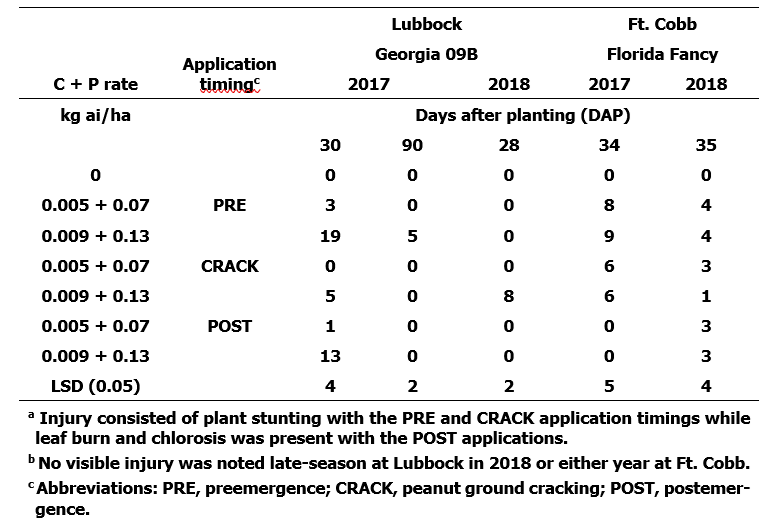
Peanut injury with carfentrazone plus pyroxasulfone (C + P) applied at three different timings during the growing season.a,b
+ 0.13 kg/ha applied CRACK. No other injury was noted with C + P rate or application timing. No late-season injury was seen with any application. In a previous study in the Texas High Plains, pyroxasulfone applied PRE at 0.09 or 0.18 kg/ha resulted in some peanut stunting but it was not consistent over years (Dotray et al., 2018).
At Ft. Cobb in 2017, C + P applied PRE and CRACK at both rates resulted in peanut stunting; however, no leaf burn/chlorsis was noted following the POST application (Table 2). In 2018, only C + P applied PRE resulted in any stunting. In previous work with pyroxasulfone in Oklahoma, peanut stunting was observed with PPI and PRE treatments with injury ranging from 4 to 13% (Baughman et al., 2018).
Peanut stunting has been noted when using either carfentrazone or pyroxasulfone alone but no documented reports could be found when used in combination. Carfentrazone stunting has been noted with POST applications 35 to 36 DAP (Grichar et al., 2010). This stunting ranged from 7 to 10% when evaluated 60 to 65 days after application across 3 runner cultivars. In Georgia, Eure et al. (2015) reported that peanut stunting during two years of testing with pyroxasulfone applied PRE ranged from 3 to 11% in one year and 38 to 55% in another, depending on peanut cultivar. They reported several factors played a role in the differences observed between the two years. More rainfall occurred during peanut CRACK in the year with greater injury than in the year with lesser injury (50.8 mm vs. 25.4 mm). Prostko et al. (2013) documented transient peanut stunting at one of two locations following pyroxasulfone applied PRE. Also, enhanced peanut stunting has been observed following the application of PRE herbicides under cool, wet conditions (Grichar et al., 2004).
In other crops, pyroxasulfone has shown greater crop injury when applied PRE on course-textured soils than on fine-textured or organic soils (Cahoon et al., 2012; Eure, 2013; Koger et al., 2008; Nurse et al., 2011; Odero and Wright, 2013). Sweet corn injury has been documented to be greater than 10% following pyroxasulfone at 0.25 kg/ha on soil with 82% sand (Nurse et al., 2011) while no injury has been observed on soils high in organic matter (Odero and Wright, 2013). In cotton, Koger et al. (2008) reported only transient injury on a silt loam soil following pyroxasulfone applied PRE.
Yield
No attempt was made to combine yield data over years at Yoakum since different varieties were used in each year. Yield differences were seen between years at the High Plains locations while data were combined over years at Ft. Cobb due to a lack of treatment by year interaction. (Table 3).
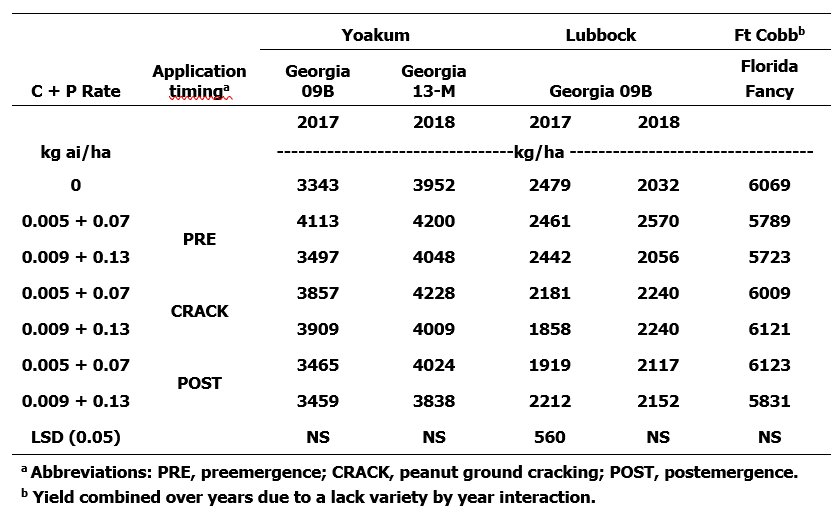
Peanut yield response to carfentrazone plus pyroxasulfone (C + P) applied at three different timings during the growing season.
No differences in yield between any C + P rates or application timings were noted at Yoakum when evaluated either on Georgia 09B or Georgia 13-M (Table 3). At Lubbock in 2017 there was a C + P rate by timing interaction as C + P at 0.009 + 0.13 kg/ha applied CRACK and C + P at 0.005 + 0.07 kg/ha applied POST reduced peanut yield when compared with the untreated check (Table 3). There was no effect on yield in 2018 at Lubbock with C + P rate or application timing. At Ft. Cobb, C + P rate or application timing had no effect on Florida Fancy yield.
No documented evidence could be found on the effect of C + P on peanut yield; however, studies on the effect of carfentrazone or pyroxasulfone alone on peanut yield have been reported (Baughman et al., 2018; Chaudhari et al., 2017; Dotray et al., 2010; Grichar et al., 2010). Dotray et al. (2010) reported that carfentrazone at 0.04 kg/ha applied 28 to 51 DAP reduced yield at 2 of 6 locations while the same rate applied 93 to 121 DAP reduced yield at 1 of 6 locations. Grichar et al. (2010) in a two-yr study reported that carfentrazone at 0.03 or 0.04 kg/ha applied 35 to 36 DAP in south Texas reduced peanut yield both years while the same rate applied 51 to 56 DAP in the Texas High Plains reduced yield in one of two years. Chaudhari et al. (2017) found that carfentrazone at 0.017 or 0.035 kg/ha applied 4 wks before digging (WBD) reduced peanut yield 10% but did not reduce yield when applied 1 to 2 WBD.
Baughman et al., (2018) in a 2 yr study reported at one location there was no difference in yield between the untreated check and any pyroxasulfone treatment and the authors attributed this to the lack of adequate U. texana control with any herbicide treatment while at the other location all herbicide systems yielded more than the untreated check. The herbicide system that included pyroxasulfone at 0.06 kg/ha applied PRE and late postemergence (LPOST) provided the greatest yield. Eure et al. (2015) reported that treatments that included pyroxasulfone at 0.12 kg/ha yielded similar to treatments without pyroxasulfone; however, pyroxasulfone applied at 0.24 kg/ha reduced peanut yield 6%. Prostko et al. (2013) did not observe a yield loss following pyroxasulfone applied PRE.
Studies in other crops have reported some yield reductions when using pyroxasulfone and results can vary by crop (Boydston et al., 2012; Hulting et al., 2012; Soltani et al., 2012; Mahoney et al., 2014; McNaughton et al., 2014; Tidemann et al., 2014). Winter wheat showed minimal injury or yield reductions at doses up to 0.15 kg/ha (Hulting et al., 2012). Potato (Solanum tuberosum L.) also showed tolerance to pyroxasulfone at rates up to 0.15 kg/ha with minor yield reduction and quality losses (Boydston et al., 2012). Pyroxasulfone at 0.125 kg/ha caused unacceptable yield losses in barley (Hordeum vulgare L.) as well as durum wheat and oats (Avena sativa L.) (Soltani et al., 2012). Sunflower (Helianthus annus L.) also has shown acceptable tolerance to pyroxasulfone up to 0.33 kg/ha although injury (but not yield loss) did occur at locations with heavy precipitation events shortly after application (Olsen et al., 2011).
Grade
Peanut grade was influenced by C + P rate and application timing at Yoakum in 2017; however, no differences were noted in 2018 at Yoakum or Ft. Cobb in 2017 (Table 4). In fact, C + P increased the percent sound mature kernels (SMK) + sound splits (SS) and reduced the percent other kernels (OK) over the untreated check. No other research could be found reporting on peanut grade response when using C + P.
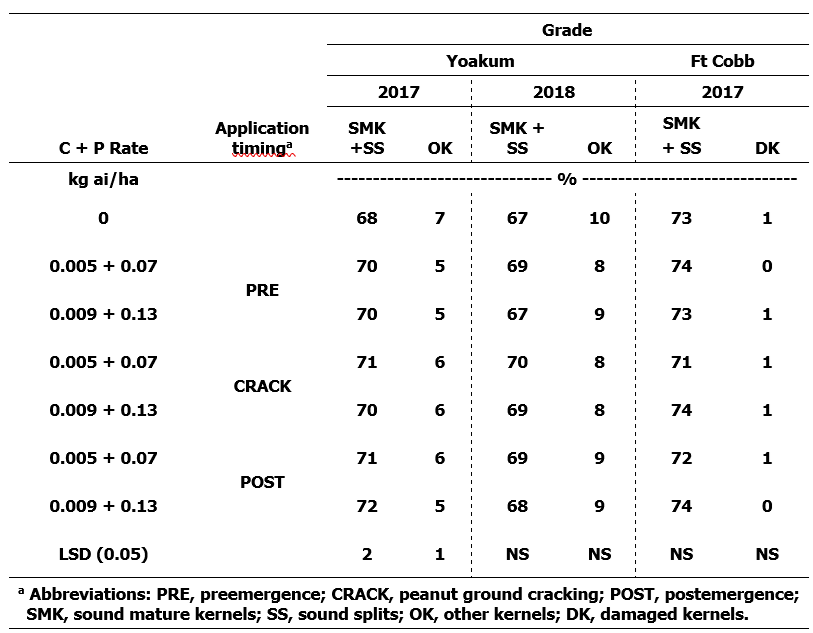
Peanut grade response to carfentrazone plus pyroxasulfone (C + P) applied at three different timings during the growing season.
The results of these studies indicate that C + P is safe to use on peanut in Texas and Oklahoma with only occasional issues with rate and/or application timing. Therefore, more research is needed on the conditions that are responsible for peanut injury which may be seen in certain areas of the southwestern U.S. peanut production area.
Acknowledgements
The Texas Peanut Producers Board and the Oklahoma Peanut Commission provided funding for this research.
Literature Cited
Anonymous. 2024. Georgia-09B peanut. Georgia’s Integrated Cultivar Release System. https://georgiacultiavrs.com/cultivar/Georgia-09b-peanuts.
Anonymous. 2020a. Specimen label-Anthem Flex® herbicide. FMC Corp. Agricultural Products Group. Philadelphia PA. 19 pp.
Anonymous. 2020b. FMC Offers New Postemergence Herbicide Option for Peanut Growers. FMC Corp. Agricultural Products Group. Philadelphia, PA 2020. Available from: https://ag.fmc.com/us/en/fmc-news/news-release-fmc-offers-new-postemergence-herbicide-option-peanut-growers.
Anonymous. 2019. Farmer’s stock peanuts. Inspection Instructions. USDA. https://ams.usda.gov/sites/default/files/media/FarmersStockPeanutsInspectionInstructions.pdf. 95 pp.
Anonymous. 2017a. Aim product label. FMC Corporation. Agricultural Products Group. Philadelphia, PA. 20 pp.
Anonymous. 2017b. Zidua product label. BASF Corporation. 26 Davis Drive, Research Triangle Park, NC 27709. 26 pp.
Anonymous. 2016. Peanut varieties. North Carolina State Univ. https://nccrop.com/varieties.php/6/Peanut.
Anonymous. 2008. Florida Fancy. Florida Seed Foundation Producers, Inc. https://apps.ams.usda.gov/CMS//Adobelmages/200800231.pdf.
Baughman T. A., Grichar W. J., and Dotray P. A.. 2018. Weed control and peanut tolerance using pyroxasulfone in Oklahoma. J. Exp. Agric. Internatl. 21(3):1-11. Article No. [: JEAI. 39881].
Becerril J.M., and Duke S.O.. 1989. Protoporphyrin IX content correlates with activity of photobleaching herbicides. Plant Physiol. 90:1175-1181.
Boydston R. A., Felix J., and Al-Khatib K.. 2012. Preemergence herbicides for potential use in potato (Solanum tuberosum) production. Weed Technol. 26:731-739.
Branch W. D. 2010. Registration of ‘Georgia-09B’ peanut. J. Plant Registration. 4:175-178. doi: [: 10.3198 /jpr2009.12.0693crc].
Branch W. D. 2014. Registration of ‘Georgia-13M’ peanut. J. Plant Registration. 8:253. doi: [: 10.3198/jpr2013.11.0071crc].
Brecke B. J. and Colvin D.L.. 1991. Weed management in peanuts. pp. 239-251 In Pimentel D., ed. CRC Handbook of Pest Management in Agriculture, 2nd edition, CRC Press, Boca Raton, FL.
Cahoon C. W., York A. C., and Jordan D. L.. 2012. Cotton tolerance and Palmer amaranth control with Zidua, Warrant, and Dual Magnum herbicides. Proc. 2012 Beltwide Cotton Conf. p. 1535.
Cahoon C.W., York A.C., Jordan D.L., Seagroves R.W., Everman W.J., and Jennings K. M.. 2015. Cotton response and Palmer amaranth control with pyroxasulfone applied preemergence and postemergence. J. Cotton Sci. 19:194-211.
Chaudhari S., Jordan D., and Jennings K.. 2017. Peanut (Arachis hypogaea L.) response to carfentrazone-ethyl and pyraflufen-ethyl applied close to harvest. Peanut Sci. 44:47–52.
Culpepper A. S., Grey T. L., Vencill W. K., Kichler J. M., Webster T. M., Brown S. M., York A. C., Davis J. W., and Hanna W. W.. 2006. Glyphosate-resistant Palmer amaranth (Amaranthus palmeri) confirmed in Georgia. Weed Sci. 54:620-626.
Curran W. and Lingenfelter D.. 2016. Pyroxasulfone: The new kid in the neighborhood. Penn State Extension. http://extension.psu.edu/plants/crops/news/2013/04/pyroxasulfone-the-new-kid-in-the-neighborhood.
Dayan F. E., Duke S. O., Weete J. D., and Hancock H. G.. 1997a. Selectivity and mode of action of carfentrazone-ethyl, a novel phenyl triazolinone herbicide. Pesticide. Sci. 51:65-73.
Dayan F. E., Weete J. D., Duke S. O., and Hancock H. G.. 1997b. Soybean (Glycine max) cultivar differences in response to sulfentrazone. Weed Sci. 45:634-641.
Devine M.D., Duke S.O., and Fedtke C.. 1993. p 177-188 In Physiology of Herbicide Action. Englewood Cliffs, N. J. Prentice Hall.
Dotray P. A., Baughman T. A., Grichar W. J., and Woodward J. E.. 2018. Performance of pyroxasulfone to control Amaranthus palmeri and Salsola kali in peanut. J. Exp. Agric. Internatl. 23(2):1-10. Article No. [: JEAI. 41505].
Dotray P. A., Baughman T. A., and Grichar W. J.. 2010. Peanut response to carfentrazone-ethyl and pyraflufen-ethyl applied postemergence. Peanut Sci. 37:52-57.
Eure P. M. 2013. An assessement of cotton tolerance to pyroxasulfone, acetochlor, and metolachlor. Proc. 2013 Beltwide Cotton Conf. p. 660.
Eure P. M., Prostko E. P., and Merchant R. M.. 2015. Peanut cultivar response to preemergence applications of pyroxasulfone. Peanut Sci. 42:39-43.
Frans R., Talbert R., Marx D., and Crowley H.. 1986. Experimental design and techniques for measuring and analyzing plant responses to weed control practices. pp. 29-46 In: Camper N.D., editor. Research Methods in Weed Science. 3rd ed. Champaign, IL : Southern Weed Sci. Soc.
Grichar W. J., Dotray P. A., and Baughman T. A.. 2024. Weed control in peanut (Arachis hypogaea L.) using carfentrazone plus pyroxasulfone herbicide systems. In: Legume Crops-Cultivation, Uses, and Benefits. https://doi.org/10.5772/intechopen.1006181.
Grichar W. J., Dotray P. A., and Baughman T. A.. 2021. Carfentrazone plus pyroxasulfone combinations for weed control in peanut (Arachis hypogaea L.) J. Exp. Agric. Internatl. 43(10):52-63. Article no. [: JEAI.75865].
Grichar W. J., Dotray P. A., and Baughman T. A.. 2019. Evaluation of weed control efficacy and peanut tolerance to pyroxasulfone herbicide in the south Texas peanut production area. J. Exp. Agric. Internatl. 29(2):1-10. Article No. [: JEAI. 45347]. doi:10.9734/JEAI/2019/45347.
Grichar W. J., Dotray P. A., and Baughman T. A.. 2010. Peanut variety response to postemergence applications of carfentrazone-ethyl and pyraflufen-ethyl. Crop Protect. 29:1034-1038.
Grichar W. J., Besler B. A., Dotray P. A., Johnson III W. C., and Prostko E. P.. 2004. Interaction of flumioxazin with dimethenamid or metolachlor in peanut (Arachis hypogaea L.). Peanut Sci. 31:12-16.
Hardwick J. M. 2013. Evaluation of pyroxasulfone in corn (Zea mays L.) and soybean (Glycine max L. Merr.) weed management programs. Master’s Thesis. School of Plant, Environmental, and Soil Science. Louisiana State University. 71 pp.
Henning R.J., Allison A.H., and Tripp L.D.. 1982. Cultural practices. pp. 123-138 In Pattee H. E. and Young C. T., eds. Peanut Science and Technology. Amer. Peanut Res. Educ. Soc., Inc. Yoakum, TX.
Hulting A.G., Dauer J.T., Hinds-Cook B., Curtis D., Koepke-Hill R.M., and Mallory-Smith C.. 2012. Management of Italian ryegrass (Lolium perenne spp. multiflorum) in western Oregon with preemergence applications of pyroxasulfone in winter wheat. Weed Technol. 26:230-235.
King S.R. and Garcia J.O.. 2008. Annual broadleaf control with KIH-485 in glyphosate-resistant furrow-irrigated corn. Weed Technol. 22:420-424.
Knezevic S.Z., Datta A., Scott J., and Porpoglia P.. 2009. Dose-response curves of KIH-485 for preemergence weed control in corn. Weed Technol. 23:340-345.
Koger C.H., Bond R., Poston D.H., Eubank T.W., Blessitt J.B., and Nandula V.K.. 2008. Evaluation of new herbicide chemistry: Does KIH-485 have a fit in the southern cotton producing region? Proc. 2008 Beltwide Cotton Conf. p. 1738.
Leon R., Jordan D., Grichar W.J., Johnson III W.C., Morichetti S., Baughman T.A., Dotray P.A., Prostko E., and Grey T. L.. 2025. Biology and management of weeds in peanut (Arachis hypogaea L.). Peanut Sci. 52(2):57-81. doi: [: 10.3146/0095-3679-52.2-PS1641].
Lovell S.T., Wax L.M., Horak M.J., and Peterson D.E.. 1996. Imidazolinone and sulfonyl-urea resistance in a biotype of common waterhemp (Amaranthus rudis). Weed Sci. 44:789-794.
Mahoney K.J., Shropshire C., and Sikkema P.H.. 2014. Weed management in conventional-and no-till soybean using flumioxazin/pyroxasulfone. Weed Technol. 28:298-306.
Mangin A.R., Hall L.M., Schoenau J.J., and Beckie H.J.. 2017. Influence of tillage on control of wild oat (Avena fatua) by the soil-applied herbicide pyroxasulfone. Weed Sci. 65:266-274.
McNaughton K.E., Shropshire C., Robinson D.E., and Sikkema P.H.. 2014. Soybean (Glycine max) tolerance to timing applications of pyroxasulfone, flumioxazin, and pyroxasulfone + flumioxazin. Weed Technol. 28:494-500.
Mueller T.C. and Steckel L.E.. 2011. Efficacy and dissipation of pyroxasulfone and three chloroacetamides in a Tennessee field soil. Weed Sci. 59:574-579.
Nurse R.E., Sikkema P.H., and Robinson D.E.. 2011. Weed control and sweet maize (Zea mays L.) yield as affected by pyroxasulfone dose. Crop Protect. 30:789-793.
Odero D.C. and Wright A.L.. 2013. Response of sweet corn to pyroxasulfone in high organic matter soils. Weed Technol. 27:341-346.
Olsen B.L., Zollinger R.K., Thompson C.R., Peterson D.E., Jenks B., Moechnig M., and Strahlman P.W.. 2011. Pyroxasulfone with and without sulfentrazone in sunflower (Helianthus annuus). Weed Technol. 25:217-221.
Peterson D.E. 1999. The impact of herbicide-resistant weeds on Kansas agriculture. Weed Tech. 13:632-635.
Prostko E.P. 2013. Weed control update. 2013 Peanut Production Update. pp. 47-65 In Beasley, Jr. J.P., (ed.) Cooperative Extension Service Series CSS-12-0110, University of Georgia, Athens GA.
SAS Institute. 2019. SAS® Enterprise Guide 8.2 User’s Guide. Cary, NC.
Sherman T.D., Becerril J.M., Matsumoto H., Duke M.V., Jacobs J.M., Jacobs N.J., and Duke S.O.. 1991. Physiological basis for differential sensitivities of plant species to protoporphyrinogen oxidase inhibiting herbicides. Plant Physiol. 97:280-287.
Sikkema S.R., Soltani N., Sikkema P.H., Robinson D.E.. 2008. Tolerance of eight sweet corn (Zea mays L.) hybrids to pyroxasulfone. Hort. Sci. 43:170-172.
Soltani N., Nurse R.E., Robinson D.E., and Sikkema P.H.. 2008. Response of pinto and small red Mexican beans (Phaseolus vulgaris L.) to pre-plant incorporated herbicides. Weed Biol. Manag. 8:25-30.
Soltani N., Shropshire C., and Sikkema H.. 2012. Response of spring planted cereals to pyroxasulfone. Internat. Res. J. Plant Sci. 3:113-119.
Tanetani Y., Kaku K., Kawai K., Fujioka T., and Shimizu T.. 2009. Action mechanism of a novel herbicide, pyroxasulfone. Pesticide Biochem. Physiol. 95:47-55.
Tanetani Y., Fujioka T., Kaku K. and Shimizu T.. 2011. Studies on the inhibition of plant very-long-chain fatty acid elongase by a novel herbicide, pyroxasulfone. J. Pesticide Sci. 36:221-228.
Theodoridis G., Baum J.S., and Hotzman F.W.. 1992. Synthesis and herbicidal properties of aryltriazolinones. A new class of pre- and post-emergence herbicides. Am. Chem. Soc. Symp. Ser. 504:135-146.
Tidemann B.D., Hall L.M., Johnson E.N., Beckie H.J., Sapsford K.L., and Ratz L.L.. 2014. Efficacy of fall- and spring-applied pyroxasulfone for herbicide-resistant weeds in field pea. Weed Technol. 28:351-360.
Tillman B., Gomillion M., McKinney J., and Person G.. 2015. Peanut variety performance in Florida, 2011-2014. https://wfrec.ifas.ufl.edu/media/wfrecifasufledu/docs/pdf/variety-trials/peanut/EDIS-Tillman-Peanut-Variety-Performance-in-FL-2011-2014-for-EDIS.pdf.
Van Gessel M.J. 2001. Glyphosate-resistant horseweed from Delaware. Weed Sci. 49:453-459.
Van Wychen L. 2022. Survey of the most common and troublesome weeds in broadleaf crops, fruits, & vegetables in the United States and Canada. Weed Sci. Soc. of America National Weed Survey Dataset. Available: https://wssa.net/wp-content/uploads/2022-Weed-Survey-Broadleaf-crops.xlsx.
Westra E., Shaner D., Westra P., and Chapman P.. 2014. Dissipation and leaching 0f pyroxasulfone and S-metolachlor. Weed Technol. 28:72-81.
Wilcut J.W., York A.C., Grichar W.J., and Wehtje G.R.. 1995. The biology and management of weeds in peanut (Arachis hypogaea). pp. 207-244 In Pattee H. E. and Stalker H. T., eds. Advances in Peanut Science. Amer. Peanut Res. Educ. Soc., Inc., Stillwater, OK.
Notes
- First author: Senior Research Scientist, Texas A&M AgriLife Research, Corpus Christi, TX 78406; Second author: Texas A&M Agrilife Research, Lubbock, TX 79403; Third author, Texas AgriLife Research and Texas AgriLife Extension Service, Lubbock, TX 79403. [^] Corresponding author’s E-mail: james.grichar@agnet.tamu.edu